 Bouncebit
Bouncebit liquid custody supported collateral reuse and managed yield under product-specific access and exit conditions
Bouncebit liquid custody paired custodied assets with wallet-held tokens for supported onchain uses in the legacy and V3 models. Its useful fit was collateral reuse or strategy exposure without moving the underlying assets into every application. Binance’s August 31, 2026 notice reports the decision to permanently retire the chain; a former BB-Token balance alone doesn’t establish usable collateral or a supported exit. Prime’s bank-custodied yield products have separate access and redemption terms. Following that decision, suitability rests on the specific product and the rights attached to the actual position.
The Asset and the Intended Use
Deposited assets shaped the custody claim, while the token’s particular model shaped how that claim could be used in an application.
Legacy Custody Vouchers
The legacy liquid custody token (LCT) model issued voucher-like tokens against assets held in centralized custody. Its one-for-one representation preserved a usable token while the underlying stayed with a custodian. The model included a bridge-based route into the former chain. That route and its application support belonged to the legacy arrangement.
V3 Vault Positions
V3 described BBTC and BBUSD as rebasing vault positions, with their underlying assets held at CEFFU. Users held the BB-Tokens representing those positions in their wallets. Supported applications could use those positions on the former EVM settlement layer. The rebasing model reflected vault performance through changes in the token balance.
The Former Custody-to-Token Sequence
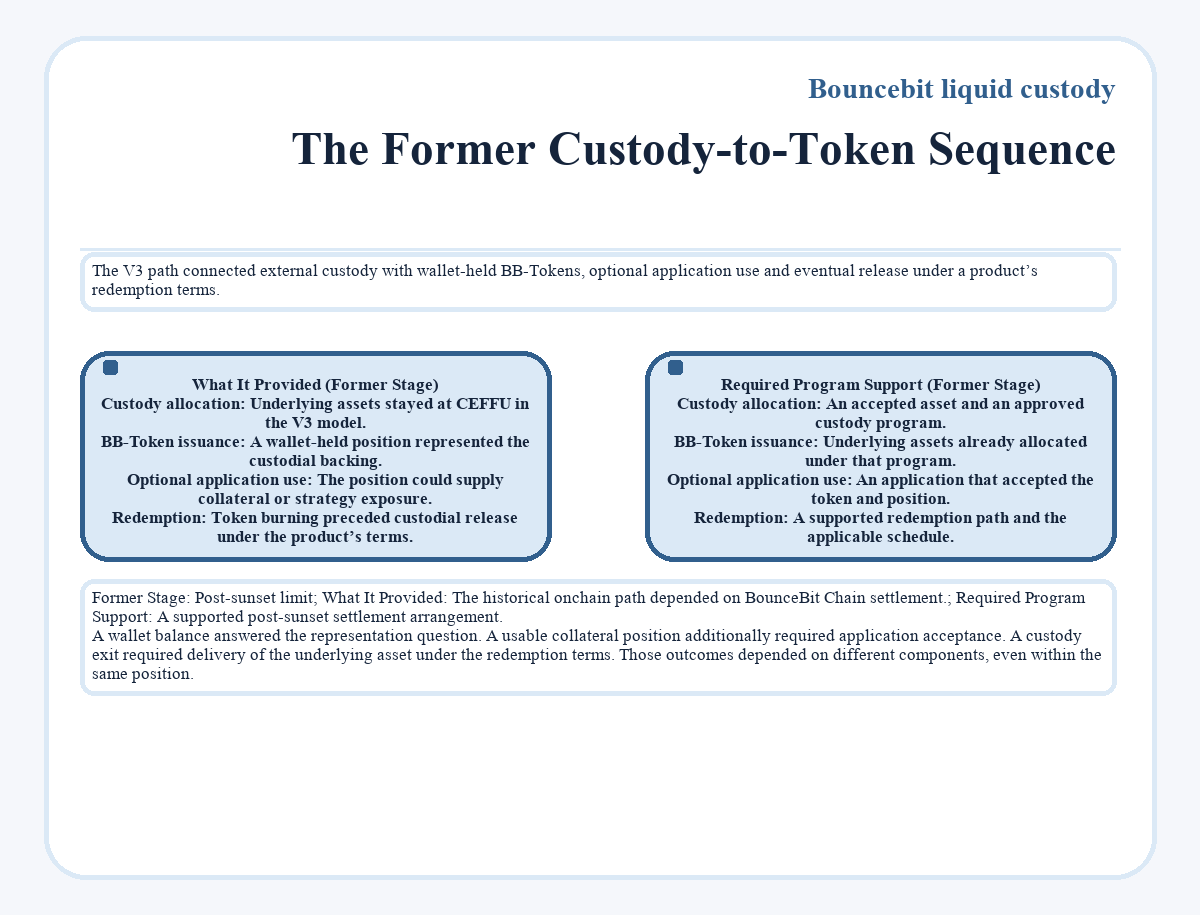
The V3 path connected external custody with wallet-held BB-Tokens, optional application use and eventual release under a product’s redemption terms.
| Former Stage | What It Provided | Required Program Support |
|---|---|---|
| Custody allocation | Underlying assets stayed at CEFFU in the V3 model. | An accepted asset and an approved custody program. |
| BB-Token issuance | A wallet-held position represented the custodial backing. | Underlying assets already allocated under that program. |
| Optional application use | The position could supply collateral or strategy exposure. | An application that accepted the token and position. |
| Redemption | Token burning preceded custodial release under the product’s terms. | A supported redemption path and the applicable schedule. |
| Post-sunset limit | The historical onchain path depended on BounceBit Chain settlement. | A supported post-sunset settlement arrangement. |
The Former Custody-to-Token Sequence
- What It Provided (Former Stage) Custody allocation: Underlying assets stayed at CEFFU in the V3 model. BB-Token issuance: A wallet-held position represented the custodial backing. Optional application use: The position could supply collateral or strategy exposure. Redemption: Token burning preceded custodial release under the product’s terms.
- Required Program Support (Former Stage) Custody allocation: An accepted asset and an approved custody program. BB-Token issuance: Underlying assets already allocated under that program. Optional application use: An application that accepted the token and position. Redemption: A supported redemption path and the applicable schedule.
Former Stage: Post-sunset limit; What It Provided: The historical onchain path depended on BounceBit Chain settlement.; Required Program Support: A supported post-sunset settlement arrangement.
A wallet balance answered the representation question. A usable collateral position additionally required application acceptance. A custody exit required delivery of the underlying asset under the redemption terms. Those outcomes depended on different components, even within the same position.
Which Uses Matched the Former Liquid Custody Model?
The former model suited collateral reuse where applications accepted BB-Tokens, managed income through a CeDeFi subscription or added rewards through validator delegation or eligible Farm participation.
Collateral for Accepted Applications
BB-Tokens could participate in supporting money markets, perpetuals and other applications. Collateral value depended on application acceptance, oracle pricing and market liquidity. This suited borrowing or trading only while the application and chain settlement supported the token. The custodian retained the underlying assets even when an application used the token. In V3, recovering the backing still required the applicable BB-Token burn-and-release path.
Managed Strategy Exposure
A subscription to a CeDeFi strategy connected custody-backed exposure with managed execution. This suited capital reserved for variable funding income when the selected strategy’s lockups and exit schedule matched the holder’s liquidity needs. For the legacy LCT route, Premium Yield required locking the voucher. Its archived mainnet terms imposed a seven-day initial lock and a seven-day wait after unstaking before principal could be claimed. That claim preceded the separate custody withdrawal. The documented BounceBit Earn vault rules separately barred redemption for 28 days after the initial subscription and used weekly processing.
Optional Staking Rewards
The legacy BBTC route combined centralized custody with validator delegation. Staking BBTC produced stBBTC, representing the staked position. Its redemption entitlement concerned the staked tokens, with adjustments for rewards and penalties. That commitment added validator exposure and required an unstaking request followed by a claim before BBTC could be returned for custody withdrawal. A position also locked in Premium Yield had to leave that strategy first.
In V3, eligible BB-Tokens could enter Farm to earn stBB-denominated incentives in the former architecture. Node-staking rewards funded those incentives. Farm eligibility and an operating reward mechanism controlled access. Earning those stBB incentives required opting into Farm; participation didn’t change the BB-Token position’s custody redemption rights.
Custody Separation in Prime Strategies
Prime’s Active Yield products connect tokenized cash equivalents with funding strategies while Standard Chartered holds client assets under institutional custody. Off-exchange collateral mirroring links those holdings to venue execution, including OKX in Prime’s custody arrangement. The bank retains the underlying assets while the strategy uses collateral value for trading.
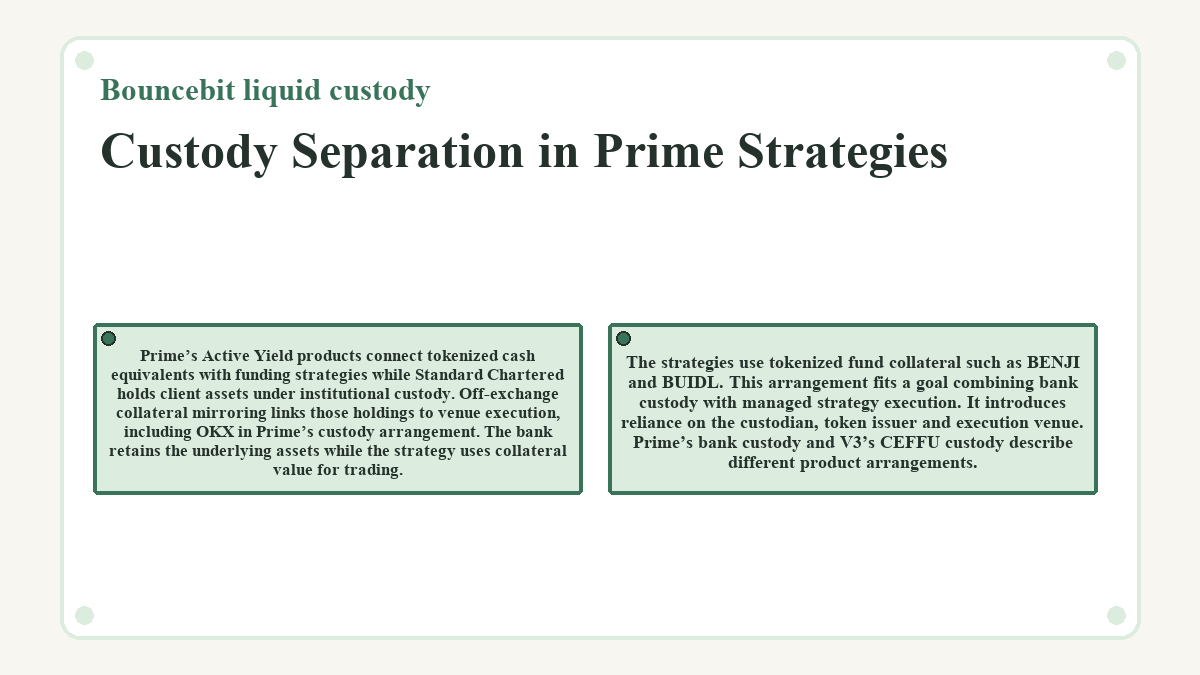
The strategies use tokenized fund collateral such as BENJI and BUIDL. This arrangement fits a goal combining bank custody with managed strategy execution. It introduces reliance on the custodian, token issuer and execution venue. Prime’s bank custody and V3’s CEFFU custody describe different product arrangements.
Why Didn’t a Wallet Token Guarantee Liquid Funds?
A wallet token represented custodied backing; pause controls could restrict transfers, and the custody program determined when and how the underlying asset could leave custody.
Application Liquidity
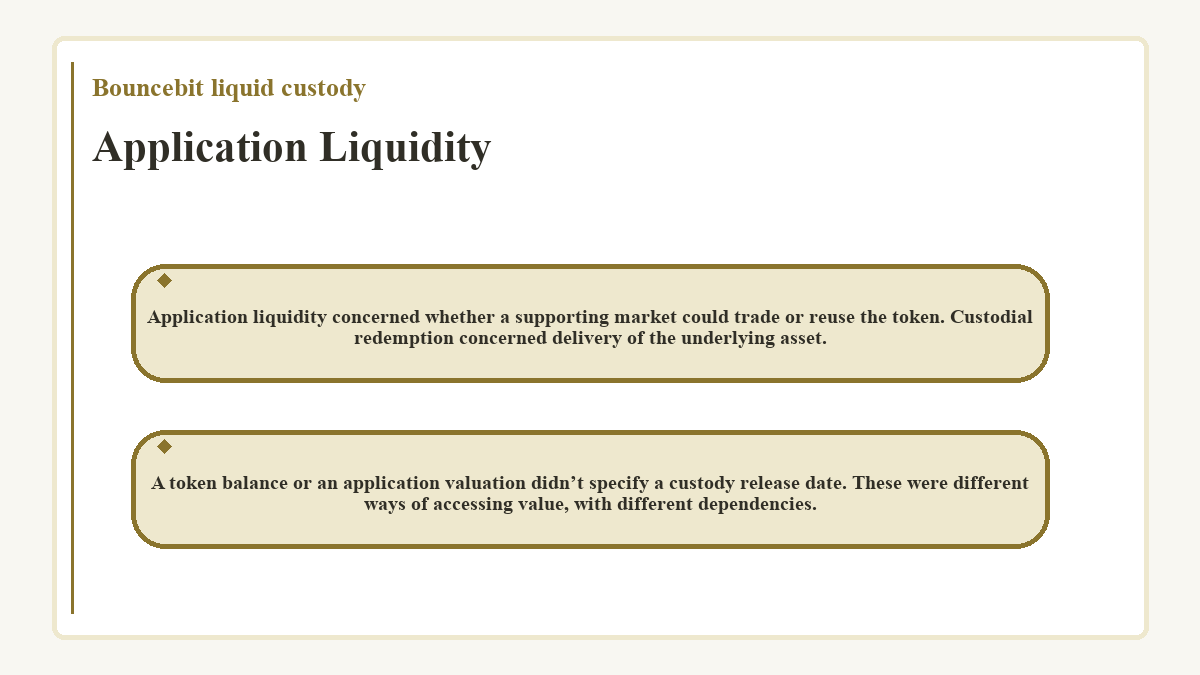
Application liquidity concerned whether a supporting market could trade or reuse the token. Custodial redemption concerned delivery of the underlying asset. A token balance or an application valuation didn’t specify a custody release date. These were different ways of accessing value, with different dependencies.
Custodial Settlement
Prime Active Yield’s stated redemption window is 11 to 15 days, depending on request timing within weekly batches. Market stress can delay settlement.
That schedule makes the product a poor match for capital that must become available at short notice. Holders can submit a redemption request at any time; payment follows the settlement cycle. Token mobility or a visible position doesn’t compress the product’s settlement cycle.
Funding Returns and the Value of Collateral
A funding strategy fits an income goal only when the holder can accept changes in funding payments and exposure to its trading counterparties. The positive-funding strategy paired spot ownership with an equivalent short perpetual position. Its hedge sought to offset price exposure while funding payments supplied strategy income. The direction of those payments mattered to the return. The negative-funding variant sold borrowed coins on the spot market and took a matching long perpetual position, introducing a borrowing dependency.
Prime layers the funding strategy onto tokenized cash-equivalent collateral. The collateral’s underlying fund yield and the strategy’s trading income contribute different components of the return. Treasury yields and derivatives funding rates can change. Negative funding can reduce or eliminate Active Yield’s strategy yield, and counterparty or custody failures can affect principal.
Keeping collateral productive therefore adds strategy exposure. It doesn’t turn the custody arrangement into a fixed-return deposit.
The Chain Sunset and the Scope of BB Migration
A hacking incident preceded the announced permanent chain retirement in August 2026. The BB migration announced on August 31, 2026 specified a 1:1 swap from the former mainnet to BNB Smart Chain.
BB’s contract swap and a custody-backed vault claim concerned different assets. The swap terms covered BB; legacy BBTC, BBUSD and liquid staking positions need their own applicable settlement arrangements. The BB swap ratio doesn’t calculate the underlying assets that a vault redemption would return.
The Cost of a Planned Custody Exit
Prime Active Yield charges a redemption fee of 0.1% of the redeemed amount. The fee covers capital movement and operational costs. The product sets a minimum redemption of $500,000; balances below that threshold require full redemption. A goal requiring partial redemptions below that minimum conflicts with those terms, even when the strategy otherwise suits the desired exposure. Trading utility and partial-withdrawal flexibility are separate requirements.
Can Liquid Custody Fit a New Commitment After the Sunset Announcement?
Prime’s institutional custody arrangement can suit an eligible investor seeking variable managed yield, subject to its capital threshold and redemption schedule. That choice differs from settling claims left in the former chain model.
Prime’s RWA Strategy Vaults require qualified investors who have completed Know Your Customer (KYC) procedures. Active Yield accepts USDT and requires a minimum investment of 500,000 USDT. Meeting that amount alone doesn’t establish investor qualification or completion of identity checks. These requirements make eligibility and committed capital part of product fit.
Direct Asset Control Without a Custody Voucher
Direct holding is the closer match when the goal requires the underlying asset itself and doesn’t need the extra custody-backed token representation. Holding the asset without a BB-Token layer avoids that layer’s minting and redemption process. The underlying asset’s own conditions continue to apply. This choice also gives up the specific managed vault exposure or token-based application utility that the custody arrangement provided.
Direct holding is an alternative for new exposure; an existing custody voucher retains its product-specific settlement question. The holder obtains direct possession of the backing only when the custody program delivers that asset. A supported token transfer and delivery from custody remain distinct outcomes.
Practical questions about Bouncebit liquid custody
Was Premium Yield Required for Legacy Liquid Custody?
Premium Yield was optional in the legacy liquid custody model. Holding the custody voucher and committing it to a funding strategy were different choices. The Premium Yield path locked the LCT for strategy participation, while the ordinary custody-withdrawal path required the matching LCT. It offered delta-neutral funding rate arbitrage as an additional use for the assets in custody.
How Did a Liquid Custody Commitment Differ From Validator Staking?
Liquid custody committed underlying assets to centralized custody, while validator staking committed tokens to network security. An LCT represented custodied backing; a liquid staking token represented the validator-related stake. Those commitments could coexist in the legacy BBTC staking path. The former V3 Liquid Staking Module issued stBB for BB staking, a different input from the underlying assets represented by custody vouchers.
Did Bridgeless V3 Issuance Remove Reliance on the Custodian?
Bridgeless V3 issuance retained dependence on the custodian. Its mint and burn controllers mapped token supply to custodial attestations. A token’s presence in the wallet didn’t give its holder direct control over the backing at CEFFU. The custody program still governed release of the underlying assets.
Which Rule Governed Legacy Custody Withdrawals Outside Premium Yield?
The legacy custody-withdrawal rule required returning the LCT that matched the underlying asset being withdrawn. Its one-for-one representation described the amount of backing associated with that voucher. The rule concerned withdrawal from custody outside Premium Yield, so the funding strategy’s exit conditions remained separate. A backing ratio alone didn’t assign a delivery date to a custody withdrawal.
Do Prime’s Custody Partners Establish Eligibility Under Local Law?
Prime’s custody arrangements address infrastructure-level compliance, while the participant’s local obligations apply separately. Regulated custodians and token issuers don’t grant universal permission to participate in a strategy. RWA Strategy Vault eligibility also requires investor qualification and KYC completion. Laws governing tokenized assets or derivatives can affect the product’s structure and availability, regardless of where its assets are held.
Is Lock and Earn’s self-custody Description Also Applicable to Active Yield?
The self-custody language concerned Lock and Earn, while Active Yield used bank custody for client assets. Lock and Earn described staking real-world assets to support network security. Active Yield uses tokenized cash equivalents for a funding strategy. Its assets remain at Standard Chartered, and its own redemption schedule controls their return.