 Bouncebit
 CeDeFi Yield and Tokenized Assets
Bouncebit combines Portal’s crypto yield strategies with Prime’s tokenized real-world asset (RWA) strategies within a CeDeFi model of centralized finance and decentralized applications. Custodians hold underlying assets; BB-Tokens represent strategy positions in its documented architecture. Chain originally supplied Layer 1 settlement. Binance’s August 31, 2026 notice reports the decision to permanently retire Chain and migrate BB 1:1 to BNB Smart Chain. Product eligibility, application support and redemption terms depend on the selected offering. The BB migration doesn’t establish replacement vault, staking or Farm routes.
What's inside
Bottom line: In the former Chain model, BB-Tokens made custodied positions usable onchain; product custody rules and settlement schedules governed redemption.
How Do Portal, Prime and the Former Chain Differ?
Portal organizes crypto yield strategies, Prime structures tokenized asset strategies and the former Chain recorded the positions that onchain applications used.
Portal Crypto Strategies
Portal’s listed strategy assets include BTCB, USDT, ETH, BNB and SOL. Its Foundation offering manages crypto assets for compounding yield. The documented CeDeFi funding strategy offsets spot and perpetual positions to earn funding payments, so returns depend on funding rates. The V3 architecture kept underlying assets at CEFFU, while BB-Token positions could interact with supported applications on the former Chain. Asset support belongs to the selected strategy and entry route. A supported asset name doesn’t establish that every network carrying that asset has an accepted deposit route.
Prime Tokenized Collateral
Prime focuses on tokenized cash equivalents and structured strategies, including instruments from Franklin Templeton’s BENJI and BlackRock’s BUIDL. Prime accesses BUIDL through Securitize. Prime’s custody model uses Standard Chartered and separates asset safekeeping from trading execution. Its Active Yield products use tokenized Treasury and money market fund collateral in funding rate arbitrage. Those subscriptions have different requirements from Portal’s crypto strategies.
Former Chain Settlement
Chain was an EVM-compatible proof-of-stake Layer 1 that settled positions and applications on its own blockchain. EVM compatibility refers to the Ethereum Virtual Machine, the contract execution environment that developers can target. Trading, lending and other applications used the chain’s accounting for asset positions and collateral. A market also needs an integration that supports the relevant token. Blockchain compatibility alone doesn’t establish that a particular lending market accepts it.
Custody and the Former Chain’s V3 Vaults
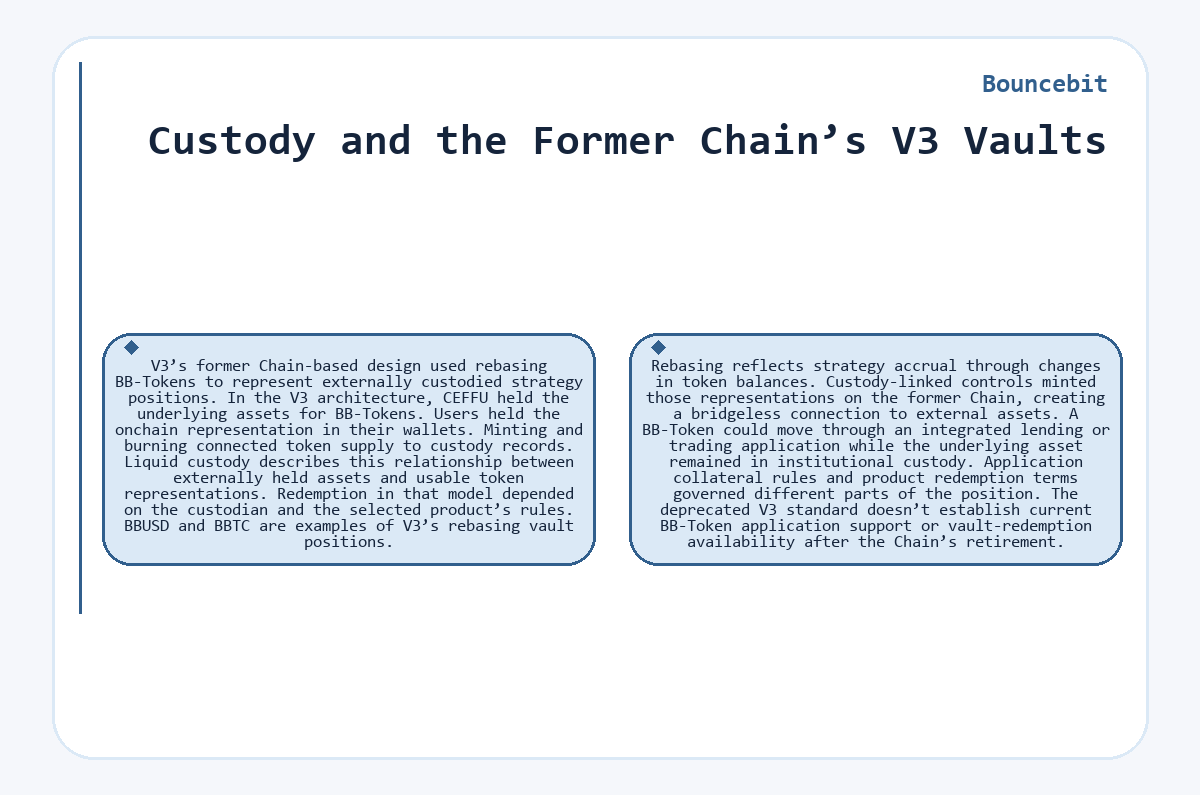
V3’s former Chain-based design used rebasing BB-Tokens to represent externally custodied strategy positions. In the V3 architecture, CEFFU held the underlying assets for BB-Tokens. Users held the onchain representation in their wallets. Minting and burning connected token supply to custody records. Liquid custody describes this relationship between externally held assets and usable token representations. Redemption in that model depended on the custodian and the selected product’s rules.
BBUSD and BBTC are examples of V3’s rebasing vault positions. Rebasing reflects strategy accrual through changes in token balances. Custody-linked controls minted those representations on the former Chain, creating a bridgeless connection to external assets. A BB-Token could move through an integrated lending or trading application while the underlying asset remained in institutional custody. Application collateral rules and product redemption terms governed different parts of the position. The deprecated V3 standard doesn’t establish current BB-Token application support or vault-redemption availability after the Chain’s retirement.
Former Chain Properties and BB Supply
The former Chain’s EVM execution environment, proof-of-stake consensus and BB’s published supply cap describe different properties, from contract compatibility to network security and token supply. They don’t determine a vault’s yield. BB was the former Chain’s native asset; the migration token is a BEP-20 asset on BNB Smart Chain.
| Parameter | Value | Function | Applicable Constraint |
|---|---|---|---|
| Former Chain Execution | Ethereum Virtual Machine | Smart-contract execution | Legacy Chain integration doesn’t establish compatibility with BNB Smart Chain |
| Former Chain Consensus | Proof of stake | Validator-based settlement | The former Chain applied staking and slashing rules to validators |
| BB Total Supply Cap | 2,100,000,000 BB | Maximum total coin supply | Total issuance cannot exceed the cap |
Application-level collateral support also depends on pricing and liquidity arrangements. Oracle conditions and available market liquidity affect how positions behave in borrowing or trading. In the former Chain model, BB-Tokens could be used in several integrated applications, each with its own market rules.
Prime Yield and External Dependencies
Prime’s Active Yield products combine tokenized cash-equivalent collateral with funding rate arbitrage, so their returns depend on fund income and derivatives-market conditions.
Fund Custody and Venue Execution
Standard Chartered provides custody for Prime client assets. Off-exchange collateral mirroring connects those positions to venue execution, including OKX, while the underlying assets stay in bank custody. Prime’s original Chain-based records supported settlement, policy controls and reporting. Custody segregation reduces reliance on exchange safekeeping, although custodian or trading-venue failures can still cause losses.
Funding Rate Strategies
Funding rate arbitrage targets the payments associated with perpetual futures markets. The RWA strategies aim for market-neutral exposure, although changing funding rates can reduce or eliminate the strategy’s yield. Fund income and strategy income can move differently. A Treasury-backed instrument may continue to accrue income while the added trading return weakens. Custodial, counterparty or exchange failures can cause losses, including principal loss.
Former Chain Staking and Farm Rewards
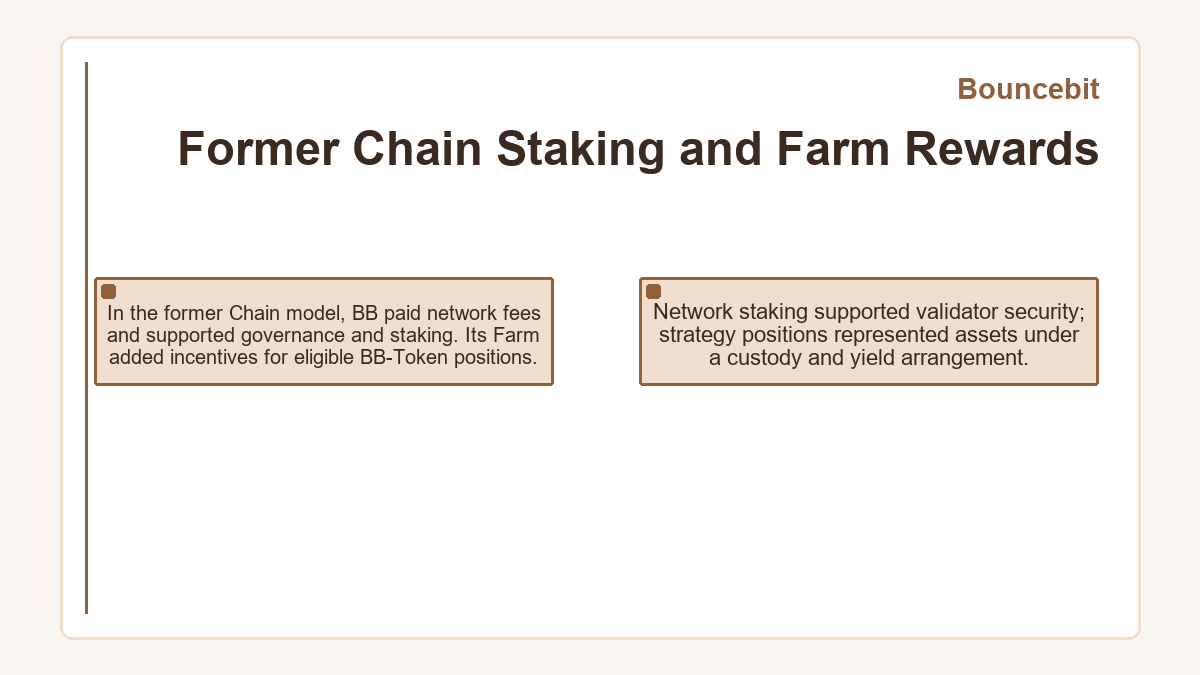
In the former Chain model, BB paid network fees and supported governance and staking. Its Farm added incentives for eligible BB-Token positions. Network staking supported validator security; strategy positions represented assets under a custody and yield arrangement.
Liquid Staking Through stBB
In the former Chain’s liquid-staking model, the Liquid Staking Module issued stBB to represent staked BB. Validator commissions and slashing rules affected staking rewards. Slashing penalized validator misbehavior and could reduce the value represented by a staking position. The documented exit required an unbonding period. That rule doesn’t specify how existing stBB, staked BB or BB undergoing unbonding are handled after the Chain’s retirement.
Farm Incentives for Eligible Positions
In the former Chain’s V3 architecture, users could optionally stake eligible BB-Tokens in the Farm. Rewards were paid in stBB from a portion of node-staking rewards. The underlying strategy’s accrual and the Farm’s incentives have different sources. Onchain parameters governed eligible assets and reward shares. Eligibility and incentive size could change with those parameters; they weren’t permanent properties of every BB-Token. The former Farm’s documented mechanics leave post-retirement access and the handling of outstanding stBB rewards unspecified.
Access, Redemption and Planned Products
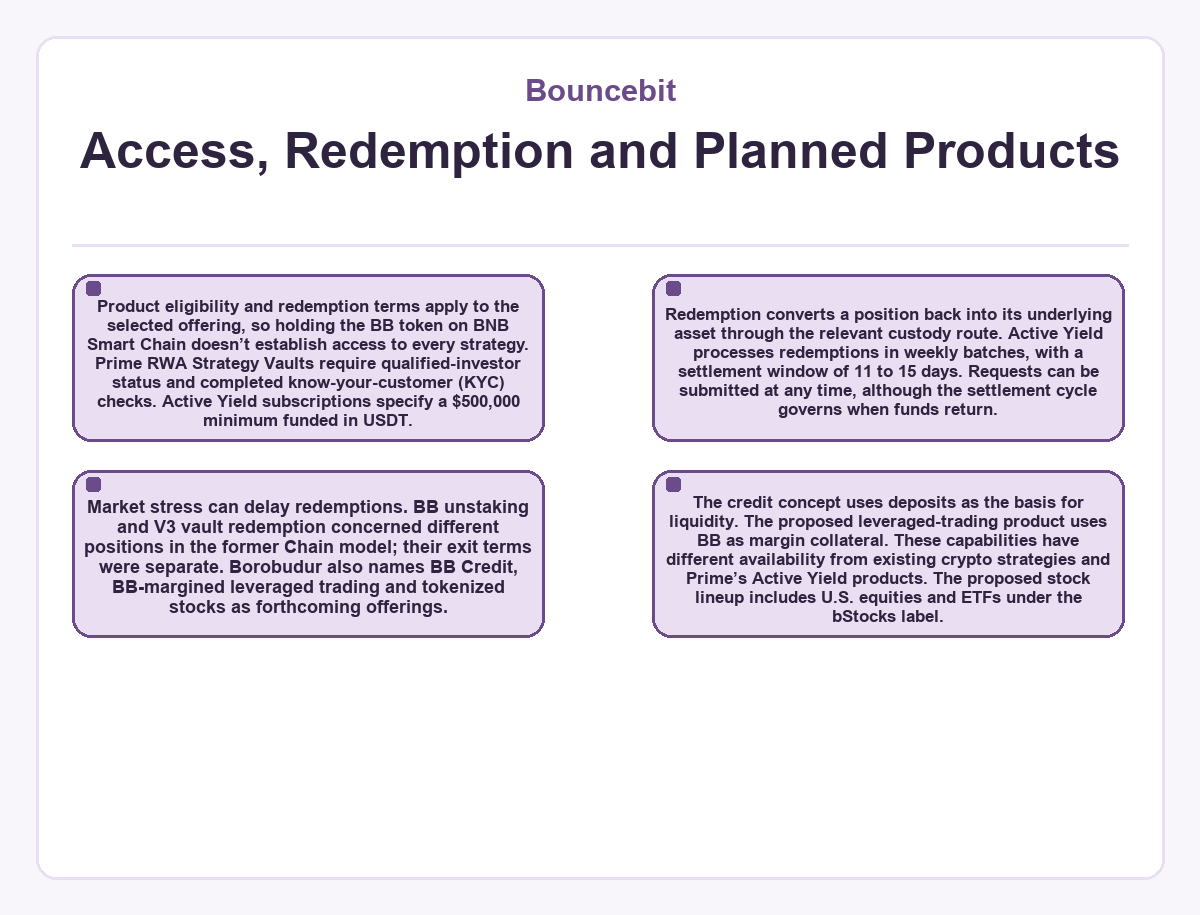
Product eligibility and redemption terms apply to the selected offering, so holding the BB token on BNB Smart Chain doesn’t establish access to every strategy. Prime RWA Strategy Vaults require qualified-investor status and completed know-your-customer (KYC) checks. Active Yield subscriptions specify a $500,000 minimum funded in USDT.
Redemption converts a position back into its underlying asset through the relevant custody route. Active Yield processes redemptions in weekly batches, with a settlement window of 11 to 15 days. Requests can be submitted at any time, although the settlement cycle governs when funds return. Market stress can delay redemptions. BB unstaking and V3 vault redemption concerned different positions in the former Chain model; their exit terms were separate.
Borobudur also names BB Credit, BB-margined leveraged trading and tokenized stocks as forthcoming offerings. The credit concept uses deposits as the basis for liquidity. The proposed leveraged-trading product uses BB as margin collateral. These capabilities have different availability from existing crypto strategies and Prime’s Active Yield products. The proposed stock lineup includes U.S. equities and ETFs under the bStocks label.
Bouncebit: questions and answers
-
Which Fees Apply to Prime Active Yield Redemptions?
- Prime Active Yield specifies a redemption fee of 0.1% of the redeemed amount. The fee covers capital movement and operational costs. This rate belongs to that redemption arrangement and doesn’t establish the fees for Portal strategies, network transactions or other Prime products.
-
Can an Active Yield Balance Below $500,000 Be Redeemed?
- An Active Yield balance below the $500,000 redemption minimum must be redeemed in full. The full-balance exception allows an exit below the normal minimum; it doesn’t establish a smaller partial-redemption amount. Processing still follows the product’s settlement cycle.
-
Why Does Prime Show Separate BENJI and Strategy APYs?
- Prime’s BENJI dashboard distinguishes fund APY, strategy APY and total APY because the fund and the added strategy generate different returns. Its displayed total uses a seven-day annualized basis. That measurement window doesn’t describe a full year of realized earnings or fix the return for future periods.
-
What Did Pause Controls Mean for BB-Tokens on the Former Chain?
- The former Chain-based CeDeFi model allowed an incident-response pause to restrict BB-Token transfers. Transfers were otherwise permissionless, and custody rules separately governed redemption. Chain’s permanent retirement decision is a separate status change; the old pause mechanism doesn’t establish a current transfer or redemption route.
-
Is BB’s Supply Cap the Amount Already Available to Trade?
- BB’s total supply cap includes coins that haven’t entered circulation. The cap is 2,100,000,000 BB, while the original token allocation provided for releases, staking rewards and vesting. A maximum-supply figure therefore doesn’t give the circulating amount at a particular time.
-
When Can a Tokenized Fund Share Be Converted Back Into Dollars?
- Cash conversion depends on the fund’s primary redemption schedule and any instant-liquidity window that it supports. Primary redemption uses fund and settlement processes that operate on business days. A fund share’s around-the-clock onchain mobility therefore doesn’t establish continuous cash availability.